Never call me Jock
by Eric Boa

I am Scottish. Born in Edinburgh, brought up in Glasgow. Both my parents were Scottish, also born in Edinburgh. I went to Aberdeen University and I have a Scottish accent. I proudly wear a kilt and can recite Tam O’Shanter, a magnificent epic poem by Robert Burns. I bristle when people say “England” when they mean “the UK”. I am a proud supporter of Scottish sports, especially rugby. Last year’s demolition of England in the Calcutta Cup was beyond brilliant. Like all typical Scots, the thrill of victories is matched by the deep despair of defeat, epitomized by the abject performance of Scotland in the Football World Cup. You want more proof that I’m Scottish? Never call me Jock, a lazy and mildly offensive name for a Scotsman. There’s more. I bristle when foreigners refer to Britain as England. It all stacks up. I’m Scottish.
Or maybe not as much as I think I am. I haven’t lived in Scotland since 1965, apart from a brief spell at university. I was 12 years-old when the family moved to Cambridge and where I attended grammar school. The choice of Aberdeen University was more because of its distance from Cambridge than any concrete notion of reasserting my Scottishness. My wife and I have owned a house in London since 1982. The last relative to live in Scotland died or moved away over forty years ago. Friends in Cambridge were forever asking if our family was returning to Scotland for Hogmanay, a traditional knees-up that straddles the end of the year. We never did. I don’t like whisky and I don’t support independence.
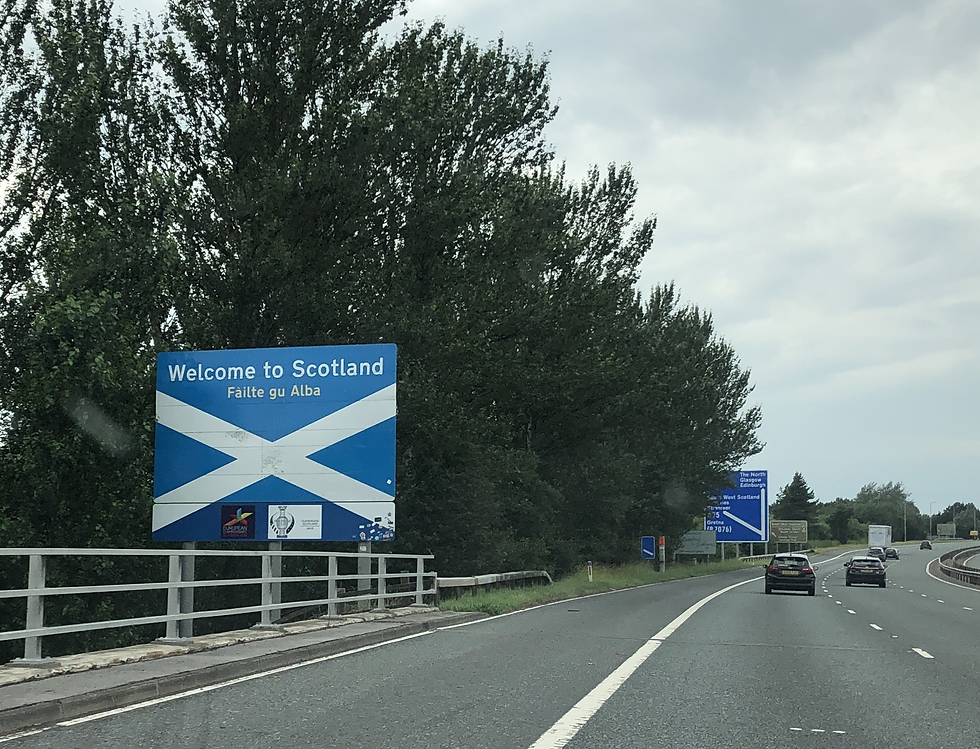
The truth is that I’m a little confused about my national identity and where I belong. I’ve observed similar confusion in other Scots who’ve moved away, even if it’s not fully acknowledged. Scots happily become fully-fledged citizens of their newly adopted countries, becoming staunchly American, Canadian or Australian. But the hankering for Scotland is never quite extinguished. Expatriate Scots eagerly join St Andrew’s and Caledonian societies and celebrate events they would often eschew if still living in Scotland. The most elaborate Burns night I’ve ever heard of was held in Jakarta, with pipers flown in, haggis imported and all the other trimmings to celebrate being Scottish. Such was the lavish display of food, drink and culture that many people attended who were not from Scotland. We were living close by but I had no desire to attend. There are more Highland Games held outside Scotland than in their traditional home. The current World Caber Tossing** Champion is Czech. Over 50 countries have featured in the Edinburgh Tattoo, a totemic display of Scottish country dancing, bagpipe-wailing and drum-beating. When I attended as a child I was thrilled by the marching and choreography of pipers and dancers. In later years I found it all rather tedious and confected, traitorous thoughts for someone still claiming to be Scottish.
The longer I’ve lived outside Scotland the more I question the meaning of being a Scot. Birthright is not destiny, as waves of migrants and their children born in the new country can testify to. Italians and Germans who settled in Rio Grande do Sol are solidly Brazilian, just as Swedes and Norwegians who moved to Upper Midwest states are loyal American citizens. New Malden, part of Greater London where I live, has the greatest concentration of Koreans in the UK. The Korean restaurants, travel agencies and supermarkets in our high street suggest a semblance of home, yet later generations born in New Malden, attending local schools and going to British universities will absorb and embed traits and behaviours that are English. The early years of life are hugely formative in shaping a sense of belonging to one place but this is not immutable. I made regular return visits to Scotland throughout my teenage years and sought reinforcement of being Scottish. Latterly it felt like nostalgia, as I came to recognize all the things I preferred about living in Cambridge.
The move to Cambridge was unsettling and disruptive. More so than moving to Bangladesh for my first job. At grammar school I was constantly teased about being Scottish. Inane remarks about kilts, sporrans and haggis from fellow pupils could be largely ignored, though not without constant effort. When teachers joined in it felt like a conspiracy. Why this concerted campaign to disparage the Scots? The result was to reinforce my feeling of being a proud Scot and to consciously retain my accent. I wanted to respond in kind but couldn’t think how to disparage Englishness. Mocking Morris Dancers made no sense. Nobody at school jumped up and down in strange outfits wearing bells on their socks. Englishness was hard to grasp and all I had to go on was the dullness and unfriendliness of everyday Cambridge folk compared to those from Glasgow, Edinburgh and Aberdeen.
Much later an English-born friend who moved to Glasgow for his secondary education told me of the harassment he had received from local pupils. I was embarrassed and mortified at the vicious way they’d treated him, holding him personally responsible, if not complicit, for centuries of English repression of the Scots. Fractious comparisons at school over where people come from can result in reinforcement of national identities or assimilation. My decision to ‘stay Scottish’ was also influenced by my mother. She adapted in her late 30’s to living in England, moving from Cambridge to Surrey and finally Leicestershire. It never stopped her lamenting lapses in how the English spoke. It was path, not path; and amn’t I, not aren’t I ***. She was ever pointing out poor grammar and other linguistic ticks, subtly implying that a Scottish education was superior. I went along with her analysis for many years, boosting the country of my birth. Then I realised this was nonsense. My grammar school was every bit as good as the private school I’d briefly attended in Glasgow. Nationality is an unreliable determinant of clear speech and crisp writing.
Yes, I disliked the monotone of East Anglian natives, but why take offence at an accent? The guttural gruffness of Glaswegians is unappealing and off-putting. Adding is that a fact? to every sentence, a linguistic tick I also associate with Glasgow, quickly becomes tedious. The longer I lived outside Scotland the more I came to recognize and grow weary of the massive chips on Scottish shoulders. Fuelled by battles lost, massacres that ensued and land stolen, historical iniquities were lovingly held in perpetuity. Robert Burns captures this well in Tam O’Shanter when his bedraggled wife is described sitting by the fire, waiting for her errant husband to return, “nursing her wrath to keep it warm”. All this angst about the English makes me question what it means to be Scottish. Being hard done-by, always the victim, never the victor? Is Culloden a battle the Scots never forget to fight?
I’m describing a Scotland that has changed, a result of devolution and other demographic and social changes. The reflex action of Scots to not only jeer at the England football team but rabidly support their opponents still exists but has become more muted. Good. It’s become harder to blame a Westminster government for all of Scotland’s ills – poor roads, underfunded public services and more. There’s also the schadenfreude generated for English consumption of the Scottish National Party’s Chief Executive splurging on expensive household items, fountain pens, computer games and a mobile home mysteriously unobserved by his wife. None of this stops me feeling Scottish, something that I remain proud of without quite being able to nail down.
I stopped being misty-eyed about Scotland years ago and celebrate living in England – well, London to be exact. I don’t want to return to the land of my birth yet I feel at home when I sit down with contemporaries. There’s something deep-seated about my birthright which will always be there. I’ve observed this in other folk who were born-there, lived-here. The owner of an agrotourismo we’d booked in Sardinia spoke excellent English. She’d lived in Watford for many years and loved it. I looked surprised, given the contrast to the glorious setting of the farm. “I know what you’re thinking”, she said, “but things worked in Watford”. Italian at heart but English in outlook.
*pronounced bow as in bow tie
**a burly gentleman in a kilt, naked from the waist up, attempts to upturn a large tree trunk (the caber).
*** Amn’t I is, I will for ever insist, the correct figure of speech. Even if younger Scots have fallen prey to aren’t I. Just think: does anyone say isn’t we? Point proven.



Comments