The Back of Beyond
Updated: Mar 22
by Eric Boa

The far northwest corner of Bangladesh pokes an uninspiring finger into India’s West Bengal. The landscape differs little from the rest of the country: a carpet of rice fields, more rice fields, scattered settlements and bamboo clumps. Flat as a paratha. The patchy tarmac road north of Panchagarh got progressively worse and eventually I stopped my Land Rover and gazed around me. I was hoping to see the the Himalayan foothills, less than 100 km away, yet even on a clear day could see nothing but rice fields. Remote, desolate yet oddly serene, I knew I had reached the 'Back of Beyond'. I was curiously satisfied for reasons I can’t quite explain.
This was back in the mid-1980s during the six years that I lived in Bangladesh. I’ve just checked on Google Maps and found a smart new highway heading towards Siliguri in India, a town squeezed between the tip of Bangladesh and the beginning of majestic mountains. My update of my journey is courtesy of Google’s StreetView. This took me up to a border post with India. Everything looked smarter and busier compared to my earlier visit. It’s still a remote place, far away from the heaving cities and mayhem of the rest of Bangladesh but is no longer to my mind the back of beyond. It made me wonder what this means, partly because I have until now associated the back of beyond with somewhere romantic, even exotic. And a nebulous sense of having achieved something unusual.
I’m also curious to explore the attractions of the back of beyond, if only because there’s a travel industry offering to take you there for large amounts of money. Where to start? The summit of Mount Everest would appear to qualify as the back of beyond. It is remote, serene, mysterious … and incredibly expensive to reach ($70k plus per person per summit). I was going to add exclusive until I remembered recent stories about people having to queue to reach the top. “Next please!” In the last year snowstorms halted ascents and over 200 people were stranded on the peak. Another 350 were led to safety. The exclusivity tag no longer seems appropriate.
Some do the ascent multiple times, diluting the sense of Mt Everest being the back of beyond. As of December 2024, 7,269 individuals had completed 12,884 summits. The climb is arduous and the sense of personal achievement on reaching the top must be immense and even overwhelming. But somehow it sounds more like a pilgrimage than a journey into the unknown. The mystery of climbing the world’s highest mountain has faded.
From the highest to one of the coldest places on Earth. The North Pole was once the epitome of remoteness and exclusivity. The earliest visitors weren’t even sure when they’d go there. How about that for mysterious! I haven’t been there myself but each year several hundred people visit. Prices start at around $25k for the basic trip, rising to double this if you put on skis. Or more if you attempt a record of some sort: first person to walk backward? If so, you will of course be sponsored and nobly raise money for a worthy cause. This means allowing the rest of the world to view your progress, with TikTok and Instagram feeds working overtime. Watching someone struggling to the North Pole on your mobile, in the comfort of your home, diminishes the notion of any destination being the back of beyond.
I’m slowly working up a list of features to define the back of beyond. To recap: remote, desolate, mysterious, perhaps serene (still not sure about this feature) and a sense of achievement once you’ve got there. I’ve thought of some more features, because now I’ve remembered a trip to Maradi in southern Niger in the 1990s. Maradi is what South Africans might call a dorp, somewhere unimpressive or even backward. Cruel, but let’s explore further. The thing about Maradi is that you’re not sure where to go next. Maradi is between nowhere and nowhere.
I am being unkind, unduly influenced by a nine-hour drive from Niamey, the capital. On the plus side, the road was excellent and the traffic light. But oh so tedious. I fell asleep and woke up several hours later thinking that we hadn’t moved. The landscape is relentlessly brown and flat. Flat as a ngome, the millet-based flatbread of neighbouring Mali. When I finally got to Maradi I knew instinctively I’d reached the back of beyond – and not in a good way. It didn’t help that my second trip to Maradi repeated the tedium of the first. Plus languishing in a guest house for three days with nothing to do because a meeting had been cancelled.
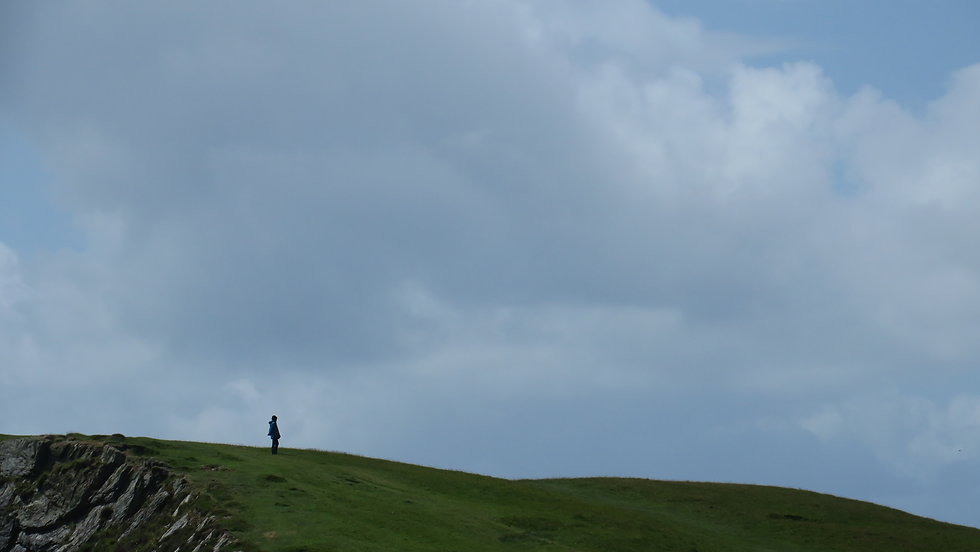
Here's the thing about the back of beyond: it’s not always an attractive place. In fact the more I think about it the nothingness of a place can be an important feature of the back of beyond. You can still feel serene or even tranquil. Cape Wrath lies on the northernmost coast of Scotland. It’s close to a field station, based at a converted school in Bettyhill, that belonged to the Botany Department of Aberdeen University, and which I visited several times in the 1970s. You have to take a small boat to cross the Kyle of Durness in order to get to Cape Wrath. Remote and desolate: tick, tick. It’s also scoured by winds and with endless vistas of the sea. All rather bleak and definitely the back of beyond.
Sir Walter Scott is credited with coining the the phrase “the back of beyond”. It first appears in his novel The Antiquary, published in 1816. He used to mean somewhere remote, isolated and, curiously, uncivilized. I didn’t notice this last epithet at first. Now it’s made me think about less exotic locations and in particular one experience in central Scotland. Alexandria may have been renewed and refreshed since the 1970s but back then it was definitely the back of beyond. And not in a good way. It seems an unlikely designation given that it’s neither remote nor mysterious. It’s north of Glasgow, on the the way to Loch Lomond, a tourist hotspot and gateway to the Trossachs National Park. The thing I remember about Alexandria was its unremitting bleakness and dreariness. I remember a major grocery store without any fresh produce. Everything was in tins.
There are good and not so good back of beyond’s. They can be mysterious, remote, desolate, uncivilized, bleak, serene and even tranquil. The back of beyond can’t be all of these things at the same time. Trying to define the back of beyond is elusive and I leave you with the attempt of US Supreme Court Justice, Potter Stewart, to define hard-core pornography. He was unable to do so but “knew it when he saw it.” Good advice for the back of beyond: you’ll know it when you get there.


Comments