Pachyderms and Pacamara don’t mix (or Geisha without the Geishas)
Updated: Apr 13
by Dr. Mark Nicholson

I have been hired by a coffee farmer on the edge of the Ngorongoro Conservation Area (NCA) in Tanzania to give advice on the endless battle between commercial farming and nature conservation. The NCA comprises the famous caldera itself plus the indigenous forest surrounding it. Sadly, I have long lost interest in the crater. In October 2001, just after 9/11, I took a client there on safari and we had the place to ourselves. Today over a million people a year visit the crater: Land Cruisers outnumber elephants, even if the crater remains a wonder of the natural world.

One side of the farm adjoins the NCA Forest, which is thick, biodiverse but is little visited by humans unlike the open savannah of the crater floor. It is exciting walking provided you keep your eyes open for larger animals than humans who sometimes prefer fight over flight. To the southwest there is a wonderful view of Lake Eyasi in the far distance.
Around 1900, about eighty German colonial farmers created small coffee farms (100-200 ha.) out of the bush around the NCA when it was part of German East Africa. Of these, about twenty farms remain which grow coffee; but they are no longer in the hands of the descendants of the original owners. One of these is where I am working.
The farm grows about eight different varieties of coffee from Ethiopia, Central America and Kenya. These include Kenyan cultivars (Ruiru 11, SL 28 & SL 34, and Batian), the popular Pacamara from El Salvador, as well as Colombian varieties. The variety Geisha from Ethiopia is still regarded as the best of all but it is not suited to all sites. A Japanese company is now buying all the Geisha from the farm at $30 a kilo which is considerably above the current world price for normal green beans (around $10 per kilo) and the Tanzania government allows this coffee to be sold directly to Japan without going through the Tanzania Coffee Board. To command such high prices, coffee bushes must be maintained in the best possible condition. That means shaded, free of coffee berry disease and leaf rust, properly pruned and above all free from the ravages of rampaging wildlife.
In recent years there have been two serious attacks on coffee pickers by elephants and buffalo. Both species tend to come into the coffee at night and disappear in the morning, so dawn and dusk tend to be the most dangerous times for walkers. Electric wires now keep elephants out but the wires also upset them.
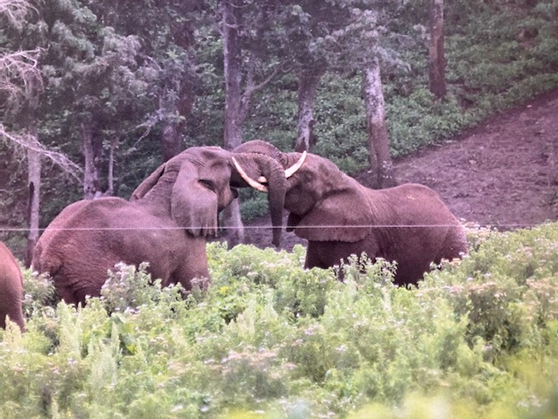
“Wapiganapo tembo, nyasi huumia”
(When giants fight, the grass (and the coffee!) gets trampled)
The Japanese Chairman of the company likes coming on safari with his interpreters. As well as visiting ‘his’ coffee, he will be bringing in groups of ‘green’ students from Japan to whom I am expected to lecture about integrating commercial farming with biodiversity. The shade trees currently being used are mostly exotic, Grevillea and Eucalyptus from Australia and an enormous and very fast-growing East Asian species (Acrocarpus fraxinifolius), a tree which gives too much shade and takes far too many nutrients and water out of the soil. It is my job to suggest and provide at least fifty species of smaller local trees which grow in the NCA, hence our walks. Indigenous tree biodiversity will eventually lead to the farmer receiving biodiversity credits from companies.

The coffee has now been surrounded by an electric fence but this in turn restricts the area for the elephants. Unfortunately, pachyderms outside of protected areas are unpopular as a result of human-wildlife conflict. Humanity will always win these days and will lead inevitably to the long-term reduction in numbers of elephants. What is a tourist attraction to foreigners is often an enemy to locals.
Coffee has always interested me since I lived in Ethiopia in the 1980s. The incorrectly named Coffea arabica[1] originates in the Ethiopian Highlands but it was misnamed by Linnaeus in 1740 when he was told that it was exported from Mokka, a port on the Red Sea in what is now Yemen. Coffea arabica is one of at least 140 species in the genus Coffea, of which at least seven grow wild in Kenya. Within this one species are hundreds, even thousands of varieties which have been selected on the basis of numerous qualities such as aroma, flavour, acidity, size of bean, productivity, soil and altitude preferences, disease resistance etc. Two months ago, I was given seed of Coffea excelsa from South Sudan, which I am told is a sizable tree far larger than other coffee species.
Worldwide, about eleven million tons of coffee are produced annually. Half of that comes from two countries - Brazil and Vietnam - but the coffee produced there (Coffea canephora or ‘Robusta’) is very inferior and is made into instant coffee. Ethiopia, the world’s fifth largest grower, produces just over half a million tons annually compared to Tanzania’s 63,000 tons. Kenya is now below 40,000 tons and falling. Why? Because the farmers believe they are being swindled by the Government. I was once told that one bean increases in cost one thousand times between farm gate and Mayfair in London. But what we lack in quantity, we make up in quality.
In the grading sheds are numerous posters on "The Art of Aroma Perception in Coffee". The aromas are broken down into twelve categories including flowery, fruity, nutty, earthy, herbal, fermented, phenolic, spicy, resinous and pyrolytic etc. Within each category are numerous imaginative descriptors such as cooked beef, leathery, smoke, roasted almonds, pipe tobacco, maple syrup, rubber and basmati rice. Next time I’m at Starbucks my opening gambit might be "I think I’ll try a cup of the one tasting of rubber and basmati rice please."
I’m sceptical of the skill and language of sommeliers…’A cheeky little red, bumptious in the aftertaste’ but I do have a story told to me by an old friend some years ago. Eugene was a Q grader, what in the old days was known in the coffee trade as a ‘spitter’, not a very glamorous title for a highly skilled profession. One day they secretly put him to the test in Nairobi. They replaced cup no. 137 with a Uganda Robusta to see if he would notice. After a waft and a spit, he exclaimed; ‘Oh come on! Who's having me on? This is a robusta…must be Ugandan…Fort Portal…west facing.’ Apparently, he was spot on.

The area on the farm and around Karatu (see map) is still dominated by an unusual tribe known as the Irakwa, who, from their name and physiognomy (especially the straight hair) suggests they originated from Iraq possibly at the same time as the Zinj colonialism of the East African coast 1400 years ago. Recent immigration into the area of thousands of locals from all over Tanzania (in search of lucrative jobs in the tourism sector) have dramatically reduced the genetic isolation of the tribe. On my last visit, members of the tribe stood out markedly. Today Irakwa blood has been much diluted since 2001.

The sumptuous guest house where I slept had one the most relaxing bathtubs in which I have ever wallowed (or swam - it is 1.8m long). The water is heated by coffee prunings. Sadly, no Geishas were on call.
[1] My Ethiopian wife insists it be called Coffea abyssinica


Comments