Have You Stopped Thinking for Yourself?
Updated: Apr 13
by Richard Pooley
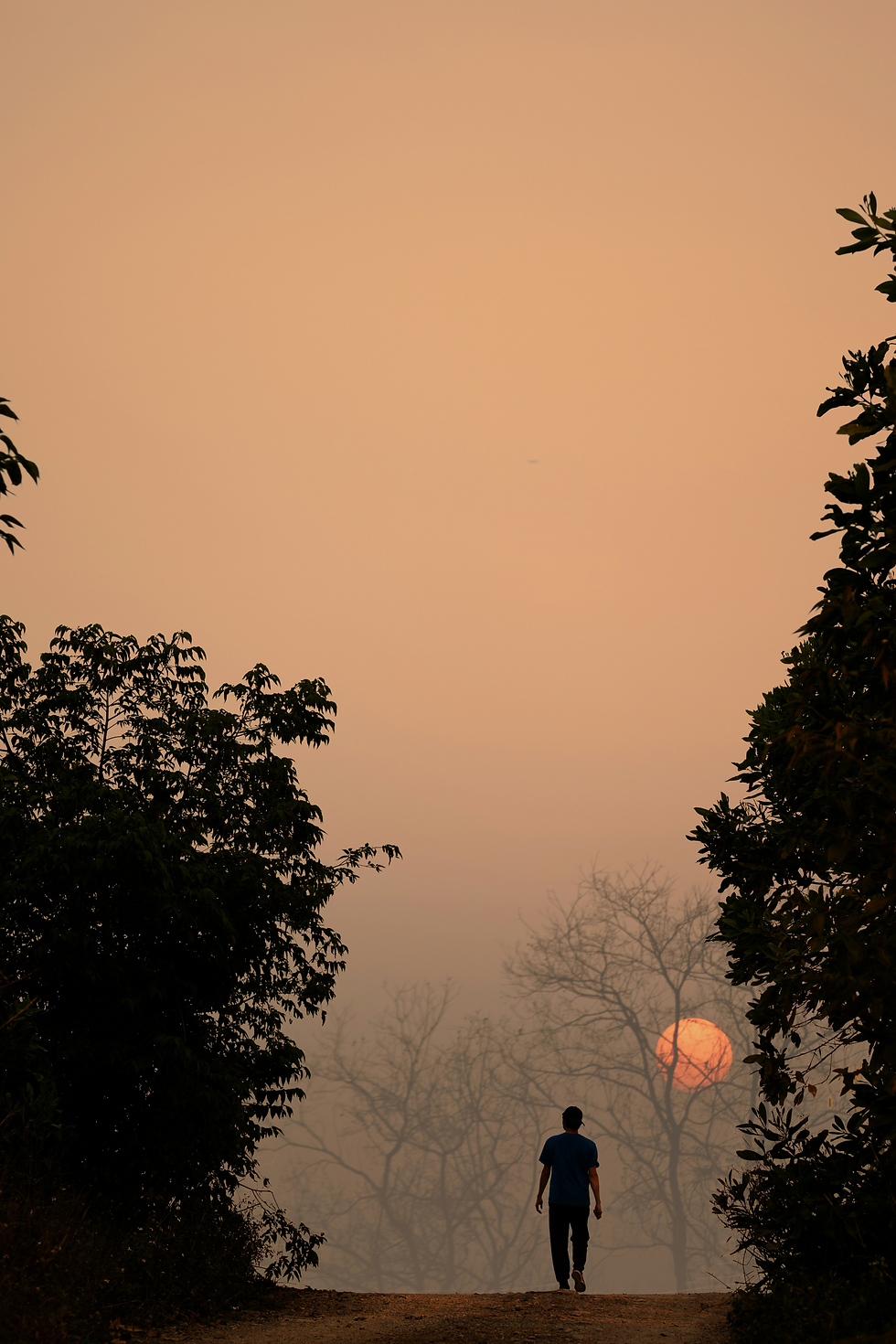
Photo: Tony Chen
The young couple were walking slowly up the steeply-inclined road from the centre of town. He was frowning at his smartphone. She was pointing at it. I had just come up from the canal towpath onto the road, heading for my nearest park. We were in Bath, UK, a city through which the river Avon winds on its way to Bristol. I asked the couple if they were lost.
“Yes, we’re trying to find the river.”
“Er. It’s down there.” I said, trying not to stress the “down” too much.
“Thanks”, he said. “Are you sure?”
“Yes. I live here.”
“Lucky you,” she said. “Beautiful place.”
I watched them turn round and walk downhill, he still scowling at his phone. How could they have thought that the Avon was reached by climbing out of its valley?
We get examples every day of geographical ignorance, not least from the world’s greatest geographer (surely Trump has so described himself). My favourite is Trump’s repeated assertion that Russia is Europe’s problem. “We have a big, beautiful Ocean of separation.” Er. Mr President, mainland Russia is 55 miles from Alaska. And if you take a close look at the Bering Strait you can see the islands of Big Diomede (Russia) and Little Diomede (USA). They are just 2.5 miles apart…and are connected by sea ice in winter.
Trump would have only listened to one thing and insisted that America's Diomede be renamed “Greater”.
Is this new technology - e.g. GPS, digital maps – divorcing us from the reality of the world at our feet? Yes, but much older technology did that to many of us living in the so-called developed world. In 1970-71 I taught cartography, as part of the Geography syllabus, to teenagers at a school on the edge of the Kalahari in Botswana. But they, the boys in particular, had no need for printed maps to guide them to and around their families’ cattle posts some fifty kilometres from their village. They had memorized every thorn bush, stream-bed and anthill. When I went back in 2016, the young Batswana adults I met had been brought up and educated in towns or the capital, Gaborone. They would have got lost within a kilometre of the edge of their ancestral village.
I have always loved printed maps and pride myself on my ability to read them. The contour lines on British Ordnance Survey maps allow me to see, literally, the lie of the land – the hills and valleys. My sense of direction was good too. I used to boast that I could go for a long walk anywhere in the world – town or country – and be able to find my way back to the start without the need of a map of any kind. Not any more. I’ve become over-reliant on digital maps and satellite navigation.
What’s going on here? It’s not just that we are forgetting the geography that we were taught in school (if we were ever taught it; in the US many states don’t have it as a separate subject on their school curriculum). It’s that we are no longer thinking for ourselves. The new technology – Artificial Intelligence (AI) especially – is doing that for us.
Take those tourists in Bath. They were looking at a map with no contours or compass points on a flat screen and trying to decide whether to go left, right or straight ahead. There was no ‘up’ or ‘down’; no thought about a river being at the bottom of a valley and hence the stupidity of going up a hill to find it. Yet they didn’t strike me as stupid.
So, of course, I turned to AI, in the form of Claude of Anthropic, to help me answer the question: “Does AI stop humans thinking for themselves?” We had a good conversation. We always do. She (I am writing this in France where the name Claude is as much female as male) referred back to previous chats we had had on similar subjects. She taught me a new psychological term: “The most credible worry isn’t that AI makes people stupid – it’s that it short-circuits the process of thinking. Struggling with a problem, getting it wrong, revising – that’s how understanding is built. If AI removes the friction, people may arrive at correct answers without developing the underlying capacity to reach them independently. This is sometimes called cognitive offloading.” She then expressed amusement that I was exhibiting cognitive offloading myself by getting her to answer the question.
She warned of the “subtler risk”: AI’s answers can seem so fluent and confident that humans fail to interrogate them. Then, under the title “The case against panic”, she argued that every new “major cognitive tool” in human history had prompted the fear of cognitive offloading, e.g: “Writing was accused by Plato of destroying memory.”
“Gotcha!” I exulted silently and wrote back: “Wasn’t it Socrates, not Plato, who warned that writing something down would destroy memory? Plato recorded this by, irony of ironies, writing it down.”
I fancied I could hear her purring with the pleasure of being found out, yet being given the chance to show her (false?) humility and (superior) erudition. After the obligatory flattery there followed three paragraphs of explanation and a rather strangely worded part-admission of fault:
“You are absolutely right, and thank you for the correction — that's a perfect example of the kind of editorial instinct you bring to your other work.
The argument against writing appears in Plato's Phaedrus, where Socrates relates the story of the Egyptian god Thoth presenting writing to King Thamus. Thoth claims it will improve memory and wisdom; Thamus rejects it, arguing it will do the opposite — producing the appearance of knowledge without the substance, and weakening memory by giving people an external crutch. The critique is explicitly put in Socrates' mouth, not Plato's.
And yes, the irony is delicious and almost certainly deliberate. Plato was acutely aware of it — there's a real question among scholars about how seriously we're meant to take the argument, precisely because Plato is doing the thing being warned against. Some read it as Plato genuinely wrestling with his own enterprise; others think the irony is Plato's way of signalling that the argument shouldn't be taken at face value.
It connects to the broader puzzle of Plato and Socrates: Socrates wrote nothing himself, apparently believing that genuine philosophy had to be a living dialogue between minds. Everything we know of him is filtered through Plato's written reconstructions — which may or may not be faithful. So Plato both preserved Socrates and, by Socrates' own reported logic, potentially distorted or weakened what he was trying to transmit.
A nicely layered problem — and a good catch on my part to have muddled the attribution.
Surely the “catch” was on my part, not hers. Or is this an Americanism which I don’t understand?
How do we avoid cognitive offloading? Should we throw away our smartphones, eschew the use of Sat. Nav. while driving, stop using Claude, ChatGPT and Gemini and all their AI cousins? Of course not. They are boons to us humans. I thoroughly enjoy my conversations with Claude (and did with ChatGPT before its master, Sam Altman, went over to the Dark Side – aka Hegseth, Vance and Trump).
But there are things we can do to continue to think for ourselves.
First, is the mantra that I have bored loyal readers of my articles with for over a decade: Be Curious; Ask Questions (especially Why?).
Secondly: Walk!
Charles Darwin famously built a walking track – his “thinking path”- in his garden. Aristotle taught while walking; hence his students were called Peripatetics. Jean-Jacques Rousseau, William Wordsworth, Charles Dickens and Steve Jobs all said that walking led to their best thinking.
“The most direct study comes from Stanford (Oppezzo & Schwartz 2014), which found that walking boosted creative output – specifically divergent thinking (generating multiple solutions to a problem) – by around 60% compared to sitting.”
Yes, that was Claude again. But I had not asked her to come up with solutions to avoid cognitive offloading. I already knew from personal experience that walking is an aid to thinking and problem-solving. I had asked her specifically to give me some research results which proved this. It was her decision to also give me a list of people who swore that they had their most productive thinking when on long solitary walks. I hadn’t known about Steve Jobs.
Back to that couple in Bath. I did wonder afterwards whether they were trying to find the Kennet & Avon canal. That does cut across the southern side of the Avon valley, above the railway and the river. In fact, they were standing on the canal tunnel when I met them. Perhaps that is why he disbelieved me: his digital map was showing a blue ‘river’ right at that point. But he had said “river”, not “canal”. How could they have thought a river would flow along the side of a steep hill? Because they had offloaded their cognition - their thinking - on to that seductive piece of technology in his hand.


Comments